
“AI trading platform” has become one of those phrases that means almost everything and, therefore, often tells you nothing. One product scans US stocks for intraday setups. Another draws trendlines and helps you test chart rules. Another turns a sentence into a backtest. A fourth is really a crypto strategy builder.
That is why I would not choose one based on an AI badge or a vendor’s win-rate screenshot. The useful question is simpler: what part of your trading workflow do you want help with? Finding ideas, defining rules, testing them, monitoring them, or sending orders are different jobs. The four tools below are the strongest fits for five different jobs—not four interchangeable “AI bots.”
1. Trade Ideas — Best AI Trading Platform for US Stock Scanning
Trade Ideas is not trying to be a universal strategy builder. Its strength is a focused one: surfacing and ranking US stock-market opportunities for active traders. Holly AI provides algorithm-driven trade ideas, while the surrounding scanner, alerts and OddsMaker research tools give a trader ways to investigate why a setup appeared.
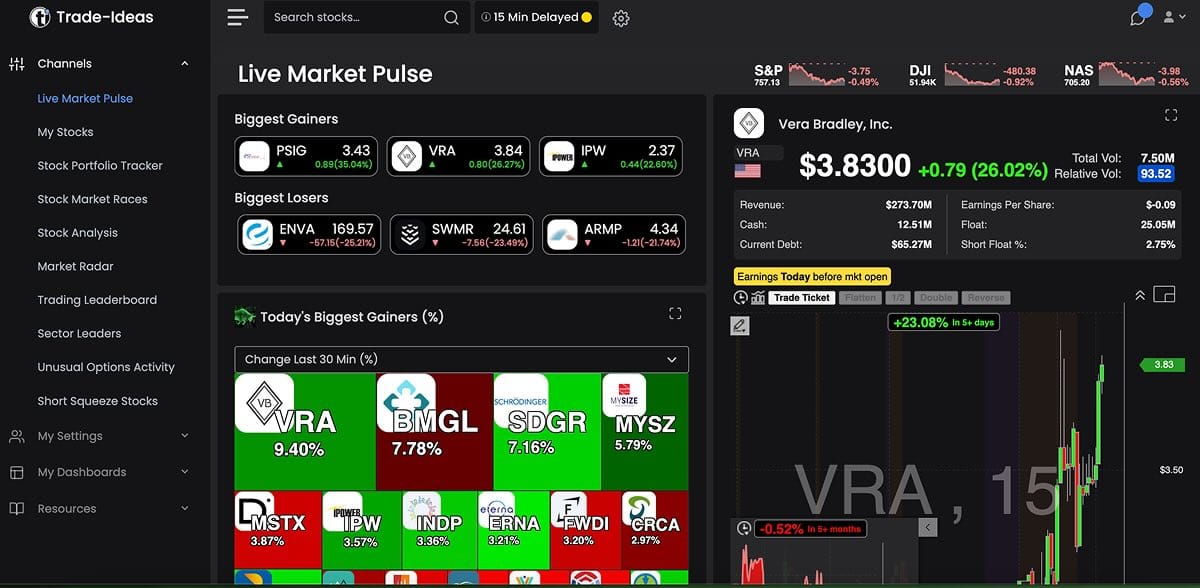
That narrowness is a feature if you trade US equities. A good scanner should help you reduce a large market to a manageable watchlist, not pretend it can understand every asset class and every trading style. Trade Ideas is built around that workflow. It also offers paper-trading features, which is the right place to test how you would actually respond to alerts before putting money behind them.
The trade-off is obvious: it is a poor fit for a forex trader looking to build an MT5 EA, a crypto trader wanting exchange-native automation, or someone who wants to write a whole portfolio model. Its paid tiers can also get expensive once real-time data and advanced AI features enter the picture.
Choose it if: your workflow begins with scanning US stocks for intraday or short-term opportunities and you want a mature, specialist tool. Treat its signals as candidates to investigate, not instructions to execute blindly.
- Built around AI-assisted US equity scanning, alerts and idea discovery.
- Holly AI and OddsMaker give active stock traders a more specialized workflow than a general-purpose chatbot.
- Paper trading and alerting help separate an idea from a live order.
- The core use case is US equities, so it is not the natural choice for forex or crypto research.
- The number of scans, alerts and features can feel overwhelming for a trader who only wants a simple backtest.
- It is primarily a research and signal platform, not a hands-off promise of automated profits.
2. TrendSpider — Best for AI-Assisted Technical Analysis and Visual Testing
TrendSpider makes more sense for a trader who thinks in charts, levels, conditions and alerts. Its core value is automation around technical analysis: trendlines, pattern work, multi-timeframe scanning and a visual strategy workflow. The platform’s Sidekick assistant and AI condition tools make it faster to get from a chart idea to a rule you can inspect.
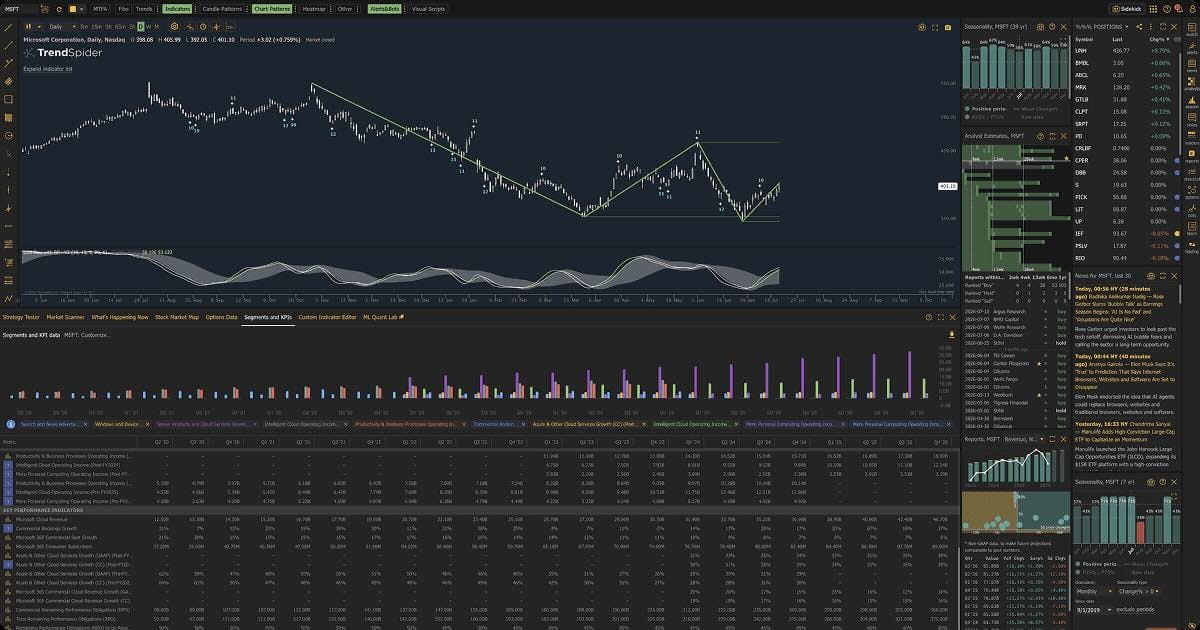
The important word is inspect. Natural-language condition entry is useful because it removes some menu work, but it is still your job to check exactly what the platform interpreted. A sentence such as “buy a strong breakout” is not a testable rule until strength, breakout, timing, sizing and exits are defined.
TrendSpider has meaningful research depth: backtesting, variance testing, forward testing, slippage and cost adjustments are available across its product tiers. But it is not a shortcut around strategy design. The practical question is whether its chart-first interface matches how you already make decisions.
Choose it if: you want to automate repetitive chart analysis and turn visual conditions into testable rules without beginning in code. Look elsewhere if you mainly want a dedicated US stock scanner or a quant-style strategy-generation engine.
- Combines automated technical analysis, charting and strategy testing in one workflow.
- Natural-language conditions and visual tools lower the barrier to testing a chart-based idea.
- Useful for traders who want to verify a setup instead of relying on an AI-generated answer.
- The broad feature set takes time to learn well.
- Plan entitlements and promotional prices change, so the live pricing page needs checking before buying.
- It is strongest for chart-led research rather than a dedicated institutional-grade portfolio engine.
3. Build Alpha — Best for Deep AI-Assisted Strategy Research
Build Alpha belongs in a more serious research category. Instead of simply translating a known rule set, it can search combinations of signals, filters, exits and parameters, then give you tools to filter, stress-test and organize the results. Its workflow is aimed at systematic traders who want more than one attractive backtest.
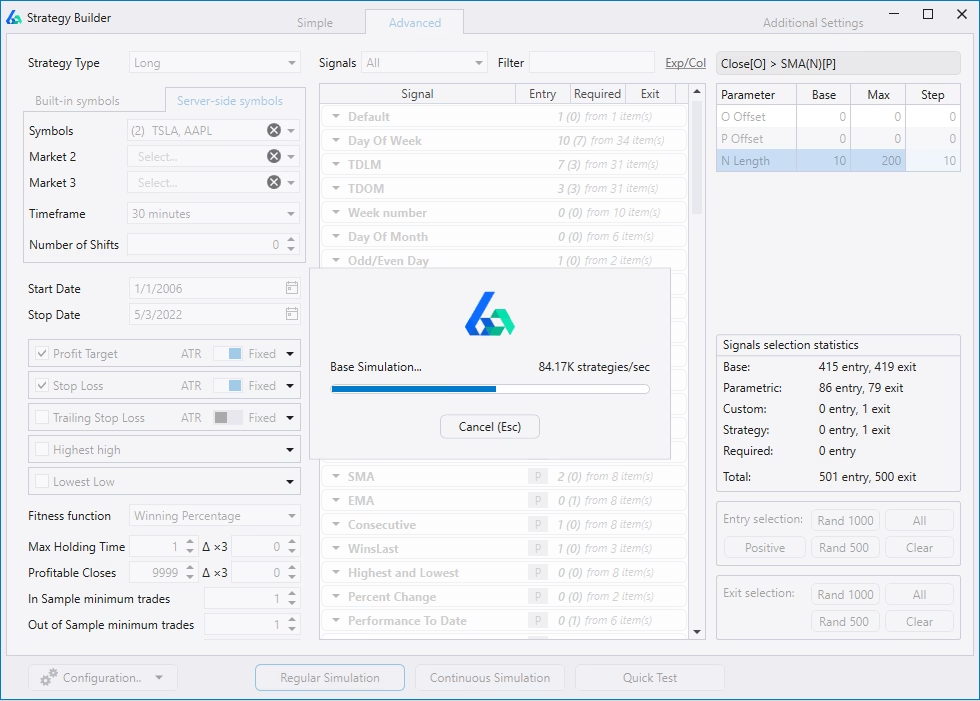
Its AI layer is not just a generic chat box. Build Alpha’s LLM Orchestrator can connect a supported third-party model (OpenAI, Claude, etc) to help select inputs, configure and iterate a research workflow around the platform’s strategy engine. You bring the relevant model API key, and the research engine still needs to be controlled with sensible constraints.
That depth comes with a learning curve and a much higher buying decision than the simpler platforms here. The current lifetime license is listed at $1,497, and there is no free trial on the pricing page. It can export code for MetaTrader and other supported environments, but code generation is not the same thing as evidence that a discovered strategy is durable.
Choose it if: you are prepared to learn a proper strategy-research process, including robustness work, and want AI to assist a controlled search rather than hand you unexplained trade calls.
- Designed for serious systematic strategy generation, robustness checks and portfolio research.
- Its LLM Orchestrator can help frame and iterate research constraints with a compatible AI provider.
- Supports a deeper research process than a simple indicator or alert tool.
- The learning curve and price are higher than lighter no-code tools.
- Robustness testing does not remove the risk of overfitting or bad assumptions.
- Using the LLM workflow requires understanding the connected provider and its API costs.
4. CoinQuant — Best AI Trading Platform for Crypto Strategy Research
CoinQuant is the cleanest fit here for someone whose main interest is crypto strategy research. You describe the logic in plain English, review the structured strategy it produces, adjust its rules and run a backtest. That is a more useful starting point than treating a crypto “AI bot” as a black box.
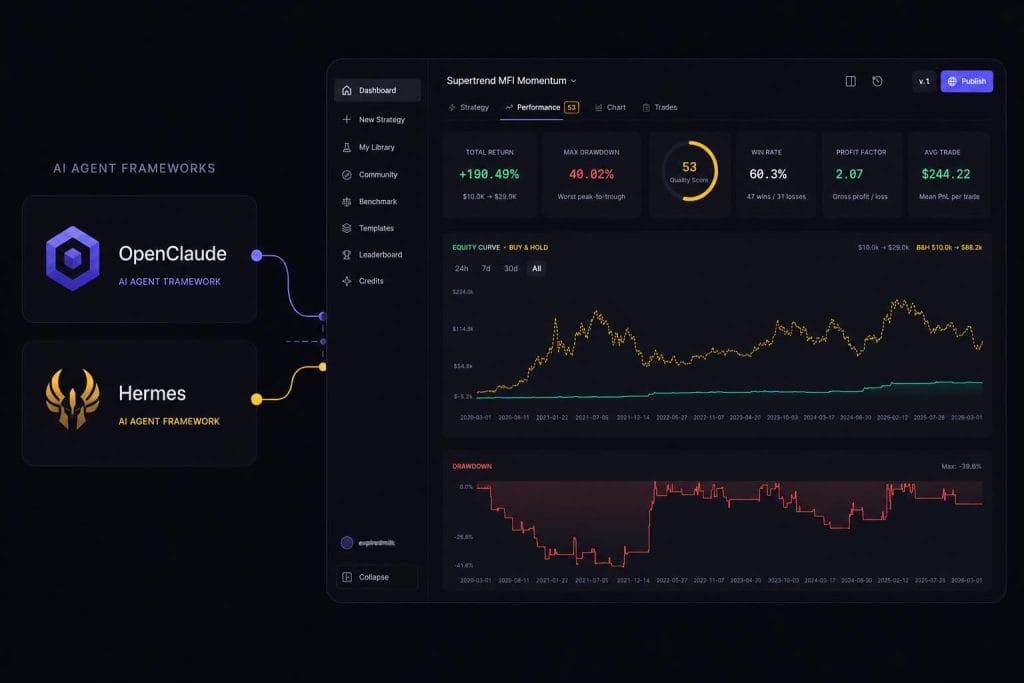
Its market coverage matters. CoinQuant documents crypto tick-level data on its Pro and Elite plans, while stocks, ETFs, forex and commodities are bar-based and plan-dependent. That does not make one type of test automatically better, but it does mean you should match the testing resolution to the strategy you are trying to evaluate.
The platform also makes an important practical point in its documentation: long or compute-heavy backtests have limits. A tool that makes a strategy easy to create is still operating within data, plan and compute constraints. Read the final rules and trade list before attaching any importance to a headline Sharpe ratio or return figure.
Choose it if: you want an approachable, no-code way to explore and backtest crypto ideas, while keeping the strategy definition visible enough to challenge it.
- Turns a plain-English strategy idea into editable logic and a backtest.
- Offers a dedicated crypto research lane, including tick-level data on qualifying plans.
- Can also be useful for non-crypto bar-data research where the available plan supports it.
- Data depth, compute capacity and asset coverage depend on the plan.
- Long or tick-level tests can use meaningful compute resources.
- Crypto backtests remain sensitive to liquidity, fees, slippage and exchange-specific execution conditions.
AI Trading Platform Comparison
The fastest way to make a bad choice is to compare these as if they perform the same job. This table is meant to make the differences obvious before you pay for a plan. Prices below were checked on September 15, 2026; vendors change plans and promotions, so always confirm the current price before subscribing.
| Platform | Primary job | What the AI does | Testing / validation | Asset focus | Pricing* | Important limitation |
|---|---|---|---|---|---|---|
| Trade Ideas | Scanning and alerts | Ranks stock ideas and supports scan research | OddsMaker and paper trading | US equities and ETFs | From $89/mo on annual billing; $127/mo monthly | Not a broad forex, crypto or EA-building platform |
| TrendSpider | Technical analysis and strategy rules | Automates analysis and helps create conditions | Backtest, variance and forward testing | Multi-asset charting | From $39 for a 14-day trial; plans and promotions vary | You must still define and inspect the rules |
| Build Alpha | Systematic strategy discovery | Assists research configuration and iteration | Robustness and portfolio research tools | Multi-market | $1,497 one-time lifetime license | High cost and substantial learning curve |
| CoinQuant | No-code strategy building | Converts plain English into editable strategy logic | Backtesting; data depth varies by plan/market | Crypto first; other markets vary | Free start; paid-plan and compute pricing to confirm | Plan and compute limits affect research scope |
*Prices are in USD and were checked on September 15, 2026. They are not a promise of the price you will see at checkout.
AI Trading Platform vs AI Trading Bot vs AI Stock Scanner
These terms are routinely used as if they describe the same product. They do not.
- An AI stock scanner searches a market for candidates that match a model or filter. It may issue alerts, but it does not necessarily build or execute your strategy.
- An AI trading platform is the broad category. It might combine research, charts, screening, strategy building, backtesting or automation, but you need to check which of those jobs it actually performs.
- An AI trading bot normally implies some level of automated order logic. That could be paper-only, manual-confirmed, broker-connected or fully automated. Never assume “bot” means it can—or should—place live trades for you.
This distinction is more than wording. A day trader who needs a fast US-equity watchlist may get no value from a deep portfolio-research engine. A trader who wants to test a written forex idea may not need an alert service. Start with the missing step in your process, then select the platform.
How to Test an AI-Generated Trading Strategy
AI can make it much easier to create a strategy. It cannot make a weak premise strong, and it cannot remove the usual sources of backtest error.
- Read the final rules. Know the exact entry, exit, sizing, trading hours, filters and handling for open positions.
- Check the data and costs. Spread, commission, slippage, funding, delayed data and symbol differences can materially change a result.
- Keep validation separate. Do not use the same historical period to invent, tune and judge a strategy. Reserve an out-of-sample period.
- Stress the assumptions. Change start dates, costs, key parameters and market regimes. A strategy that survives only one perfect setting is not robust.
- Forward-test before live risk. Use paper trading or a demo environment to see whether the signals and execution behave as expected in real time.
- Start small if you go live. Monitor actual fills, missed trades and changes in market conditions before increasing risk.
A platform’s AI score, win rate or equity curve is not a guarantee. It is, at best, a starting point for the same skeptical process you should apply to every trading idea.
How to Choose the Right AI Trading Platform
Use this short decision rule instead of trying to buy the platform with the longest feature page:
- Choose Trade Ideas if your primary job is finding US stock setups during the trading day.
- Choose TrendSpider if you want charts, automated technical analysis and visual strategy conditions.
- Choose Build Alpha if you want deeper systematic discovery and are willing to learn a rigorous validation process.
- Choose CoinQuant if crypto strategy research is your main use case and you want editable plain-English logic.
If a platform cannot explain its data, strategy logic, test assumptions and execution boundary, that is usually a reason to step back—not a reason to trust the marketing harder.
FAQ
There is no honest universal winner because AI trading platforms serve different jobs. Trade Ideas is a strong fit for US stock scanning, TrendSpider for chart-based analysis, Build Alpha for deep systematic work and CoinQuant for crypto strategy testing.
AI can help define rules, search ideas and run tests, but it cannot guarantee profitability. Historical results can be distorted by overfitting, data errors, unrealistic costs and market changes. Review the rules and validate them before risking capital.
Safety depends on the platform, its broker/exchange connection, permissions and the strategy itself. Start with research, backtesting and paper trading. If a bot can place live orders, understand its sizing, stop behavior, error handling and how to disable it before connecting meaningful capital.
Not necessarily. TrendSpider, and CoinQuant offer no-code or natural-language ways to define strategy logic. You still need enough trading and testing knowledge to recognize an unclear rule, a misleading backtest or an unsuitable risk setting.